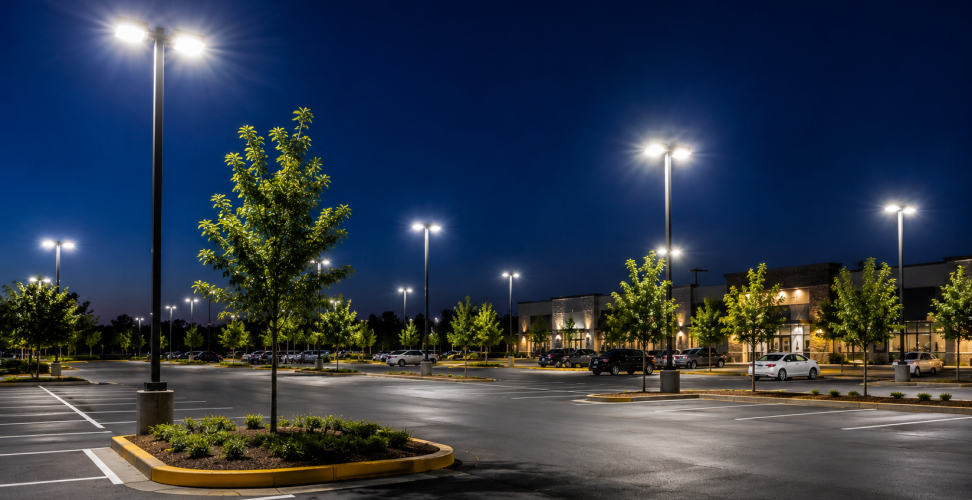
Parking lots are among the most important outdoor areas to illuminate on a commercial property. Employees, customers, tenants, visitors, delivery drivers, and pedestrians all depend on adequate visibility when entering, leaving, or moving through a property after dark. At the same time, property managers need lighting systems that are energy-efficient, durable, easy to maintain, and appropriate for the property’s layout.
That is why LED parking lot lights have become a popular choice for commercial properties in 2026. Modern LED fixtures can provide high-output illumination while offering flexible wattage, color-temperature, mounting, and distribution options. J&H LED, for example, offers commercial and industrial lighting products specifically designed for parking lots, outdoor facilities, building exteriors, walkways, and other applications.
However, choosing the right fixture involves more than finding the highest-lumen product or the lowest purchase price. Property managers should evaluate the entire lighting system, including pole height, fixture spacing, light distribution, energy consumption, glare, maintenance, environmental conditions, and future operating needs.
This guide explains what property managers should look for when selecting LED parking lot lights in 2026.
Why LED Parking Lot Lights Are a Smart Choice in 2026
Traditional parking lot fixtures can consume substantial amounts of electricity, particularly when they operate from dusk until dawn. Older metal halide and other conventional systems can also require regular lamp and ballast replacement.
LED technology changes the equation by combining efficient light output with long-term reliability.
Modern LED parking lot fixtures can offer several advantages:
- Reduced energy consumption
- Long operating life
- Lower maintenance requirements
- Consistent illumination
- Flexible wattage options
- Multiple color temperatures
- Different beam distributions
- Various mounting configurations
- Better compatibility with lighting controls
- Instant-on operation
J&H LED describes its commercial lighting products as designed to improve visibility, safety, energy efficiency, and maintenance performance across parking lots, warehouses, apartment complexes, and other commercial environments.
For a property manager responsible for dozens or hundreds of exterior fixtures, these benefits can have a meaningful impact on operating costs and day-to-day property management.
What Are LED Parking Lot Lights?
LED parking lot lights are outdoor LED fixtures designed to illuminate large areas such as parking lots, driveways, commercial properties, campuses, walkways, and building exteriors.
They are typically mounted on poles or other elevated structures so that light can spread across a relatively large area.
Unlike a simple floodlight, a dedicated parking lot fixture is designed around specific light-distribution patterns. This allows property managers and lighting designers to direct illumination where it is needed instead of simply producing light in every direction.
J&H LED currently offers parking lot products with different wattages, lumen outputs, color-temperature settings, and distribution patterns. Its product catalog includes 100W, 150W, and 240W parking lot fixtures, among other commercial outdoor lighting options.
1. Start With the Parking Lot Layout
Before choosing a fixture, property managers should understand the space being illuminated.
A small retail parking lot will have different requirements from a large distribution center or apartment community.
Evaluate:
- Total parking area
- Number of parking spaces
- Pole locations
- Pole heights
- Driving lanes
- Pedestrian walkways
- Building entrances
- Landscaping
- Trees
- Signage
- Loading areas
- Property boundaries
- Nearby buildings
The existing pole layout is also important when upgrading an older system.
A direct fixture replacement may be practical in some situations, while other properties may benefit from repositioning fixtures or modifying the overall layout.
2. Pay Attention to Lumens, Not Just Watts
One of the most common mistakes property managers make is choosing a parking lot fixture based primarily on wattage.
Wattage tells you how much electrical power the fixture uses. It does not tell you exactly how much useful light reaches the parking surface.
Lumens describe the fixture’s total light output.
When comparing LED parking lot lights, consider both wattage and lumens. You should also consider how efficiently and effectively those lumens are distributed.
For example, J&H LED’s 100W parking lot fixture provides selectable 60W, 80W, and 100W settings and offers lumen levels from approximately 7,200 to 12,000 lumens, depending on the selected setting.
This type of flexibility can be useful for property managers who need to balance illumination requirements with energy consumption.
3. Consider Light Distribution
Light distribution is one of the most important factors in parking lot lighting.
A fixture may produce thousands of lumens, but if those lumens are not distributed appropriately, the parking lot can still have dark areas or excessive brightness in other locations.
Common distribution patterns are designed for different applications.
The correct choice depends on:
- Pole location
- Pole height
- Parking layout
- Driveway configuration
- Property dimensions
- Fixture spacing
- Required coverage
J&H LED’s parking lot product selection includes Type III-S and Type III-M distribution options, demonstrating why distribution should be considered alongside lumen output.
Property managers should avoid assuming that one beam pattern will work equally well for every parking lot.
4. Evaluate Pole Height and Fixture Spacing
The same fixture can produce different results depending on how high it is mounted and how far it is from neighboring fixtures.
A fixture mounted too high may require more output or a different distribution pattern. A fixture mounted too low may produce excessive brightness in localized areas.
Spacing is equally important.
If poles are too far apart, dark areas can develop between fixtures. If they are too close together, the property may use more fixtures and energy than necessary.
This is why professional lighting layouts and photometric analysis can be valuable for larger commercial projects.
A photometric plan can model how light is distributed across the actual property instead of relying on assumptions based solely on fixture wattage.
5. Look for Selectable Wattage
Selectable wattage is an increasingly useful feature for commercial outdoor lighting.
Instead of being locked into one power level, a selectable-wattage fixture may allow installers or facility managers to choose an appropriate output.
This provides flexibility when the same fixture is used in different parts of a property.
For example, a large open parking area might require a higher setting, while a smaller peripheral area may need less output.
J&H LED’s 100W parking lot fixture offers 60W, 80W, and 100W selections, providing this type of flexibility.
6. Choose the Right Color Temperature
Color temperature affects the appearance of the light.
Commercial outdoor LED fixtures commonly offer several CCT choices.
J&H LED’s 100W parking lot fixture, for example, offers selectable 2700K, 4000K, and 5000K settings.
Property managers should consider:
- Visibility
- Visual comfort
- Existing property lighting
- Building appearance
- Local requirements
- Surrounding properties
- Security considerations
A cooler color temperature may provide a crisp, bright appearance, while a warmer temperature can create a softer visual environment.
There is no universal CCT that is ideal for every property.
7. Don’t Assume Brighter Always Means Safer
A common misconception is that the safest parking lot is the brightest possible parking lot.
In reality, lighting quality matters just as much as quantity.
Excessive brightness can create glare. Poorly controlled fixtures can produce strong contrasts between extremely bright areas and dark areas.
Effective outdoor lighting should provide useful illumination where people need it.
Research on outdoor lighting also highlights the importance of avoiding unnecessary overlighting and controlling upward or unwanted light.
Property managers should therefore focus on uniform, purposeful illumination rather than simply selecting the fixture with the largest lumen number.
8. Consider Glare Control
Glare can affect drivers, pedestrians, employees, and nearby residents.
A fixture aimed directly toward a driver’s line of sight can create discomfort and reduce visibility. Similarly, excessive light spilling into neighboring properties can create complaints.
When evaluating commercial outdoor lighting, consider:
- Fixture orientation
- Optics
- Mounting height
- Distribution pattern
- Shielding
- Property boundaries
- Nearby residences
- Adjacent roads
The objective is to illuminate the parking lot without unnecessarily illuminating neighboring buildings, windows, roads, or the night sky.
9. Evaluate the Fixture’s Outdoor Durability
Parking lot fixtures are exposed to weather throughout the year.
Depending on the location, they may experience:
- Rain
- Snow
- Ice
- Wind
- Heat
- Humidity
- Dust
- Temperature changes
- Vibration
Property managers should therefore review the fixture’s environmental and construction specifications before installation.
J&H LED states that its commercial fixtures are designed with durable materials and engineering intended to withstand conditions including weather, dust, and vibration.
The appropriate fixture should match the actual conditions at the property.
10. Think About Maintenance Access
Parking lot lights are often mounted high above the ground.
Replacing a failed fixture may require a bucket truck, lift, electrical contractor, or maintenance crew.
That makes maintenance a significant consideration when selecting LED parking lot lights.
A reliable LED fixture can reduce the frequency of replacements, but property managers should also consider how accessible the fixture is when maintenance is eventually required.
When evaluating products, consider:
- Expected operating life
- Warranty
- Driver accessibility
- Replacement availability
- Mounting system
- Local service support
- Installation requirements
Lower maintenance requirements can provide significant operational benefits over the life of the lighting system.
11. Consider Energy Efficiency
Parking lot lighting often operates for many hours every night.
That makes energy efficiency particularly important.
Even a modest reduction in wattage can become meaningful when multiplied across dozens of fixtures and thousands of operating hours.
For example:
Number of fixtures × watts per fixture × operating hours = annual energy usage
Property managers can compare the existing system with a proposed LED system to estimate potential energy savings.
Actual savings depend on the existing fixture wattage, LED replacement wattage, operating schedule, electricity rates, and other factors.
12. Consider LED Area Lights for More Than Parking Spaces
LED area lights can be useful when the property requires illumination beyond designated parking spaces.
They can support lighting around:
- Driveways
- Building exteriors
- Walkways
- Loading areas
- Outdoor workspaces
- Commercial campuses
- Warehouses
- Apartment communities
J&H LED’s product range includes outdoor area and security lighting in addition to dedicated parking lot fixtures. Its catalog also includes an integrated outdoor security light rated at 21,000 lumens and described for canopy and area-light applications.
This allows property managers to consider a broader lighting strategy instead of treating the parking lot as an isolated area.
13. Use Different Fixtures for Different Zones
A commercial property rarely needs one fixture type everywhere.
A well-planned lighting system may combine several fixture categories.
Parking Areas
Use pole-mounted LED parking lot fixtures for broad illumination.
Walkways
Use bollard or post-top lighting for pedestrian routes.
Building Entrances
Use wall packs or wall-mounted fixtures.
Loading Areas
Use area lights, wall packs, or other high-output fixtures depending on the layout.
Building Perimeters
Use security-oriented fixtures where additional visibility is needed.
Landscaped Areas
Use appropriate post-top or decorative outdoor lighting.
J&H LED’s commercial portfolio includes parking lot lights, wall packs, bollards, post lights, flood lights, canopy lights, and other outdoor products.
14. Look at Mounting Options
Mounting compatibility can determine whether a fixture is practical for an existing property.
Before ordering, check:
- Pole type
- Pole diameter
- Mounting arm
- Fixture weight
- Existing hardware
- Electrical connection
- Installation orientation
J&H LED’s 100W parking lot fixture is designed for arm mounting on round or square poles and can also support wall mounting applications.
This type of versatility can be valuable during retrofit projects where existing infrastructure needs to be reused.
15. Consider Lighting Controls
Not every parking lot needs to operate at full output all night.
Depending on the property and applicable requirements, controls may provide additional opportunities to manage energy use.
Possible strategies include:
- Photocells
- Timers
- Dimming
- Scheduling
- Occupancy-based controls
- Smart lighting systems
For many properties, dusk-to-dawn operation remains appropriate, particularly where security and continuous visibility are priorities. But controls can still be considered for specific areas or operating schedules.
16. Think About Security
Parking lot lighting is closely connected with property security.
Adequate lighting can make it easier for employees, customers, security personnel, and cameras to see activity around the property.
Important locations may include:
- Entrances
- Exit lanes
- Pedestrian pathways
- Building perimeters
- Remote corners
- Loading zones
- Areas around dumpsters
- Stairways
However, lighting should not be treated as a complete security system.
A strong commercial property security strategy may combine lighting with surveillance cameras, access controls, alarms, signage, landscaping, and other measures.
17. Consider Security Cameras When Planning Lighting
Property managers upgrading both lighting and surveillance should evaluate the two systems together.
Poorly positioned fixtures can create glare for cameras. Large differences between illuminated and dark areas can also affect nighttime visibility.
The goal should be consistent illumination across areas that cameras need to monitor.
A lighting designer or qualified contractor can help evaluate fixture placement and camera locations together.
18. Evaluate Total Cost of Ownership
The cheapest fixture is not necessarily the most economical choice.
Property managers should evaluate the total cost over the fixture’s operating life.
Consider:
Purchase cost + installation + energy + maintenance + replacement costs
A fixture with a higher initial price may make more financial sense if it offers greater efficiency, better durability, easier maintenance, or a longer useful life.
This is particularly important for large parking lots where a difference of even a small amount per fixture can multiply across an entire installation.
19. Don’t Forget the Property’s Appearance
Parking lot lighting also influences how a property looks at night.
A clean, modern lighting system can make a commercial property appear more professional and well maintained.
This can matter for:
- Retail centers
- Office buildings
- Apartment communities
- Hotels
- Medical facilities
- Corporate campuses
- Industrial properties
Post-top lights, bollards, and other decorative fixtures can complement dedicated parking lot lighting while creating a more cohesive outdoor environment.
J&H LED offers post-top and bollard products in addition to its parking lot fixtures.
20. Create a Lighting Audit Before Replacing Fixtures
Property managers should conduct a nighttime audit before beginning a major lighting upgrade.
Walk the entire property and document:
- Failed fixtures
- Dark areas
- Excessively bright areas
- Glare
- Damaged fixtures
- Poorly illuminated entrances
- Pedestrian routes
- Security concerns
- Areas requiring additional coverage
Photos and a property map can make this assessment more useful.
The audit can then become the basis for fixture selection and a new lighting layout.
21. Consider a Photometric Plan for Larger Projects
For a small property, straightforward fixture replacement may be enough.
For a large commercial parking lot, however, a photometric plan can be valuable.
A photometric analysis can help predict how light will fall across the property based on:
- Fixture type
- Lumens
- Optics
- Pole height
- Fixture spacing
- Mounting position
- Property geometry
This can help identify potential dark spots before installation.
It also allows property managers to make decisions based on the actual site rather than simply comparing product specifications.
Best LED Parking Lot Lights: A Property Manager’s Checklist
Before purchasing, review the following checklist:
Performance
- Is the lumen output appropriate?
- Is the wattage appropriate?
- Is the fixture efficient?
- Does the distribution match the parking lot?
Installation
- Is the fixture compatible with existing poles?
- Is the mounting hardware appropriate?
- Can contractors install it without major infrastructure changes?
Environment
- Is the fixture rated for outdoor use?
- Can it handle the property’s weather conditions?
- Is it suitable for heat, cold, moisture, or vibration?
Visibility
- Does it provide uniform illumination?
- Does it minimize glare?
- Will it illuminate pedestrian routes?
- Does it support security visibility?
Flexibility
- Is wattage selectable?
- Is color temperature selectable?
- Are multiple mounting options available?
- Can controls be integrated?
Long-Term Value
- What is the warranty?
- How much maintenance should be expected?
- What are the projected energy costs?
- Is replacement support available?
Why Choose J&H LED for Parking Lot Lighting?
J&H LED specializes in commercial and industrial LED lighting for applications including parking lots, warehouses, commercial buildings, apartment complexes, and outdoor spaces. The company offers parking lot lights alongside wall packs, bollards, post lights, canopy lights, flood lights, high bays, and other commercial lighting products.
Its current parking lot product range includes fixtures designed for different output levels and distribution requirements. For example, J&H LED’s 100W parking lot fixture offers selectable wattage, selectable color temperature, Type III-S distribution, and multiple mounting options.
J&H LED also publishes educational content around commercial lighting, including information about high-performance parking lot lights and energy efficiency in commercial spaces.
For property managers planning an upgrade, the company’s broader commercial product portfolio can also make it possible to coordinate parking lot lighting with building, walkway, perimeter, and outdoor area lighting.
Frequently Asked Questions
What are the best LED parking lot lights for commercial properties?
The best fixture depends on the property’s size, pole height, spacing, parking layout, required illumination, environmental conditions, and distribution requirements. Property managers should compare lumen output, wattage, optics, mounting compatibility, durability, and total cost of ownership.
How many lumens do LED parking lot lights need?
There is no single lumen number that works for every parking lot. Required output depends on pole height, fixture spacing, distribution pattern, property layout, and the desired lighting level. A photometric plan can help determine the appropriate fixture output.
Are LED parking lot lights energy efficient?
LED fixtures generally provide an efficient way to illuminate large outdoor areas, particularly when replacing older, less efficient lighting systems. Actual energy savings depend on the existing system, replacement wattage, operating hours, and electricity rates.
What color temperature is best for parking lot lighting?
The appropriate color temperature depends on the property and its lighting objectives. Modern fixtures may offer multiple CCT options, allowing property managers to choose an appearance appropriate for the environment.
Can LED area lights be used in parking lots?
Yes. LED area lights can be used for parking lots and other large outdoor spaces, although the fixture’s distribution, mounting height, and output should match the application’s requirements.
Are LED parking lot lights suitable for security lighting?
They can contribute to effective security lighting by improving visibility around parking areas, entrances, walkways, and property perimeters. However, lighting should be combined with other security measures when appropriate.
Conclusion
Choosing the best LED parking lot lights in 2026 requires property managers to look beyond the fixture’s price or wattage.
The right solution should provide appropriate illumination, efficient operation, reliable outdoor performance, practical mounting options, and a light distribution pattern that matches the property’s actual layout.
Property managers should evaluate pole height, fixture spacing, lumen output, color temperature, beam distribution, glare, environmental exposure, maintenance access, controls, and total cost of ownership before making a decision.
A successful parking lot lighting upgrade should also consider the areas surrounding the parking lot. Walkways, building entrances, loading zones, and property perimeters may require different types of fixtures. Combining dedicated parking lot fixtures with LED area lights, wall packs, bollards, post lights, and other commercial outdoor lighting products can create a more complete lighting system.
With its range of commercial and industrial LED fixtures, including parking lot lights and complementary outdoor lighting products, J&H LED can be a useful option for property managers planning commercial lighting upgrades.
The best parking lot lighting isn’t simply the brightest. It is the lighting system that puts the right amount of light in the right places, operates efficiently, withstands outdoor conditions, and continues delivering dependable performance for years to come.