Warehouses have changed significantly in recent years. Higher ceilings, taller storage racks, automated equipment, larger distribution centers, and longer operating hours have created new demands for reliable and efficient illumination. For businesses looking to improve visibility while controlling operating costs, high bay LED lighting has become one of the most practical solutions.
Choosing warehouse lighting, however, is not simply a matter of selecting the brightest fixture available. The right lighting system needs to match the building’s ceiling height, layout, work activities, mounting configuration, energy goals, and maintenance requirements. In 2026, businesses also have more options than ever, including selectable wattage, multiple color temperatures, improved optical designs, dimming capabilities, and advanced controls.
Whether you are replacing outdated fluorescent fixtures, upgrading metal halide lights, or installing lighting in a new warehouse, understanding the key factors behind modern LED high bay lights can help you make a better investment.
J&H LED provides commercial and industrial LED lighting designed for warehouses, commercial buildings, outdoor spaces, parking areas, and other demanding environments. With durable construction, energy-efficient designs, and a broad range of commercial lighting solutions, J&H LED helps businesses create safer and more efficient spaces.
What Is High Bay LED Lighting?
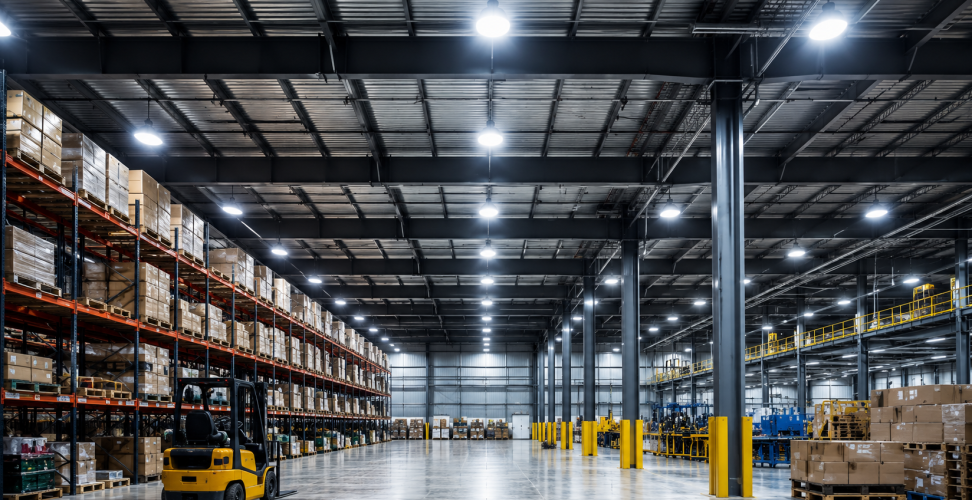
High bay LED lighting refers to fixtures designed specifically for spaces with high ceilings. Unlike standard ceiling fixtures, high bay lights are engineered to distribute substantial amounts of light over large floor areas while maintaining useful illumination at considerable mounting heights.
Warehouses are among the most common applications. Other environments may include:
- Distribution centers
- Manufacturing facilities
- Industrial buildings
- Aircraft hangars
- Automotive facilities
- Gymnasiums
- Large retail spaces
- Agricultural buildings
- Storage facilities
- Workshops
- Commercial production areas
The primary advantage of LED technology is its ability to provide high light output with comparatively low energy consumption. LEDs also typically have long operating lives, which can reduce the frequency of fixture replacement and maintenance.
For a warehouse that operates many hours per day, these advantages can make a significant difference in total operating costs.
Why Upgrade Warehouse Lighting to LED in 2026?
Older lighting technologies can create several challenges in modern warehouses. Fluorescent and metal halide systems may consume more energy, require more maintenance, and provide less flexibility than today’s LED solutions.
Modern industrial LED lighting can address many of these issues.
1. Lower Energy Consumption
Lighting can represent a meaningful portion of a warehouse’s electricity usage, particularly when facilities operate around the clock.
LED fixtures are designed to produce substantial illumination using less electricity than many traditional lighting technologies. Replacing older fixtures with efficient high bay LEDs can therefore help businesses reduce ongoing energy consumption.
The exact savings depend on the existing lighting system, fixture wattage, operating hours, electricity rates, and the number of fixtures being replaced.
2. Reduced Maintenance
Warehouse ceilings can be difficult and expensive to access.
Replacing a failed fixture may require lifts, specialized equipment, or maintenance personnel to work at considerable heights. Long-lasting LED fixtures can reduce the frequency of these maintenance interventions.
This is particularly valuable in facilities with tall ceilings or large numbers of fixtures.
3. Better Visibility
Good warehouse lighting is directly connected to visibility.
Employees need to read labels, identify inventory, operate equipment, navigate aisles, and perform detailed tasks. Poor illumination or uneven light distribution can create dark areas and unnecessary glare.
Well-designed LED high bay lights can provide more consistent illumination across the workspace when the fixtures are selected and positioned correctly.
4. More Flexible Lighting Options
Modern LED high bays are available in different wattages, lumen outputs, beam patterns, color temperatures, and mounting configurations.
Some fixtures also offer selectable wattage or selectable color temperature, allowing businesses to adjust the lighting according to the requirements of a particular space.
This flexibility can be especially useful when one facility contains multiple work areas.
How High Bay Lights Differ From Low Bay Fixtures
One of the first decisions when planning warehouse lighting is determining whether the space requires high bay or low bay fixtures.
Generally, high bay lighting is intended for higher mounting heights, while low bay lighting is designed for lower ceilings.
The exact fixture selection should not be based on ceiling height alone. You also need to consider:
- Ceiling structure
- Rack height
- Aisle width
- Required illumination levels
- Fixture spacing
- Beam angle
- Mounting position
- Work being performed
- Existing electrical infrastructure
A warehouse with tall ceilings and narrow aisles may require a very different lighting layout from a large open storage facility.
Key Factors to Consider When Choosing High Bay LED Lighting
Selecting the right fixture requires more than comparing wattages. Here are the most important factors to evaluate in 2026.
1. Ceiling Height
Start by measuring the mounting height.
The higher the fixture is installed, the more carefully you need to consider lumen output, optics, and beam distribution.
A fixture that works well at a moderate height may not provide sufficient illumination when installed much higher.
Instead of simply choosing the highest-output fixture, consider how the light will reach the working surface.
2. Lumens
Lumens measure the amount of visible light produced by a fixture.
When comparing LED high bay lights, look at lumen output rather than relying only on wattage.
Two fixtures can consume similar amounts of electricity while producing different amounts of light.
However, more lumens are not automatically better. Excessive light can increase energy use and contribute to glare.
The goal is appropriate illumination for the space and task.
3. Wattage and Energy Efficiency
Wattage indicates how much electrical power a fixture consumes.
Modern LED technology can provide high lumen output without requiring the same wattage as older lighting technologies.
When comparing fixtures, consider the relationship between wattage and lumen output.
A useful way to evaluate efficiency is lumens per watt. Higher efficacy can mean more light is produced for each watt of electricity consumed.
4. Color Temperature
Color temperature affects the appearance of the light.
Common commercial LED lighting options include:
- Warm white
- Neutral white
- Cool white
- Daylight-style white
For many warehouses and industrial environments, cooler color temperatures are preferred because they provide a crisp appearance that can make work areas feel bright and clearly illuminated.
However, the ideal choice depends on the application, employee preferences, visual tasks, and overall facility design.
Selectable CCT fixtures can provide additional flexibility.
5. Beam Angle
Beam angle determines how widely light spreads from the fixture.
This is particularly important in warehouses with shelving and storage racks.
A wide beam may be suitable for large open spaces, while a narrower distribution can be useful for focused aisle illumination.
The wrong beam pattern can lead to wasted light, excessive overlap, or dark areas.
Therefore, fixture placement and optical distribution should be considered together.
6. Mounting Options
Warehouse high bay fixtures may be installed using different mounting methods depending on the building structure.
Common approaches include:
- Chain mounting
- Pendant mounting
- Surface mounting
- Hook mounting
- Bracket mounting
Before selecting a fixture, verify that the mounting system works with the existing ceiling structure and installation requirements.
7. Color Rendering
Color rendering affects how accurately objects appear under artificial light.
A warehouse may not require the same color-rendering performance as a retail showroom, but good visibility remains important.
If employees need to distinguish product colors, labels, wiring, packaging, or safety markings, selecting an appropriate color-rendering specification becomes more important.
8. Durability
Warehouse and industrial environments can be demanding.
Fixtures may be exposed to:
- Dust
- Temperature fluctuations
- Moisture
- Vibration
- Mechanical activity
- Long operating hours
For these environments, durable construction is essential.
A high-quality fixture should be appropriate for the environment in which it will be installed.
9. Operating Temperature
Not every warehouse has the same climate conditions.
Some facilities are temperature-controlled, while others may experience significant heat or cold.
Before purchasing high bay fixtures, review their rated operating temperature range and confirm that the specification is appropriate for your facility.
This is especially important for warehouses with refrigeration, loading docks, or large areas exposed to outdoor conditions.
10. Controls and Dimming
Lighting controls are becoming increasingly important in commercial facilities.
Occupancy sensors, daylight controls, dimming, and scheduling can help reduce energy consumption by adjusting lighting according to actual usage.
For example, an area that is rarely occupied may not need to operate at full output throughout the day.
When evaluating high bay LED lighting, determine whether the fixture supports the control strategy you plan to implement.
Understanding Warehouse Lighting Layout
Choosing a high bay fixture is only part of the process.
Even an excellent fixture can perform poorly if it is installed incorrectly.
A warehouse lighting plan should consider:
Aisle Configuration
Rack layouts influence where fixtures should be positioned.
Long, narrow aisles may benefit from fixture placement that concentrates illumination along the travel path and product storage locations.
Fixture Spacing
Fixtures need to be spaced appropriately to create consistent illumination.
Installing fixtures too far apart can create dark zones. Installing too many fixtures can increase unnecessary energy consumption.
Mounting Height
Mounting height affects both coverage and intensity.
The higher the fixture, the more carefully its lumen output and distribution pattern need to be evaluated.
Obstructions
Storage racks, beams, equipment, conveyors, and other structures can block light.
A lighting plan should account for these obstacles rather than assuming an unobstructed floor.
High Bay LED Lighting for Different Warehouse Areas
Not every area of a warehouse has identical lighting requirements.
Storage Areas
Storage areas generally require consistent illumination for inventory identification, movement, and safety.
The appropriate fixture depends on rack height and aisle arrangement.
Loading and Unloading Areas
Loading docks can have different requirements because workers frequently move between indoor and outdoor environments.
Lighting should provide sufficient visibility around doors, vehicles, pallets, and loading equipment.
Manufacturing Areas
Manufacturing environments may require more task-oriented illumination.
Employees may work with machinery, tools, components, or detailed production processes.
In these areas, light quality, uniformity, and glare control can become particularly important.
Distribution Centers
Distribution centers often operate for extended hours and may contain automated systems, conveyor equipment, tall racks, and large open spaces.
Efficient industrial LED lighting can help support visibility while controlling energy and maintenance requirements.
LED High Bay Lights and Workplace Safety
Warehouse safety should always be a major consideration when designing lighting.
Adequate illumination helps employees see:
- Walkways
- Equipment
- Pallets
- Labels
- Obstacles
- Loading areas
- Emergency exits
- Safety markings
Poor lighting can make hazards harder to identify.
At the same time, excessive brightness or poorly controlled glare can also affect visual comfort.
The objective is balanced, uniform illumination rather than simply maximizing brightness.
High Bay LED Lighting vs. Traditional Warehouse Lighting
Businesses replacing older lighting systems often compare LEDs with fluorescent or metal halide fixtures.
LED Advantages
LED technology can offer:
- Lower energy consumption
- Long operating life
- Reduced maintenance
- Instant illumination
- Flexible color temperatures
- Multiple mounting options
- Improved controllability
- Durable construction
Traditional fixtures may still be present in older warehouses, but modern LED systems provide businesses with more options for efficiency and lighting control.
What to Look for in a High Bay LED Fixture in 2026
Technology continues to evolve, so buyers should consider both current requirements and future flexibility.
Look for fixtures that provide:
Selectable Wattage
Selectable wattage can allow the installer or facility manager to adjust output according to the application.
This can be helpful when the same fixture model is being used across multiple areas.
Selectable Color Temperature
Selectable CCT allows businesses to choose the most suitable light appearance during installation.
Efficient LED Performance
Evaluate lumen output relative to power consumption.
Quality Construction
Look for durable materials and construction appropriate for commercial or industrial environments.
Easy Installation
A fixture that is straightforward to install can reduce labor complexity during an upgrade.
Appropriate Certifications and Ratings
Always verify that fixtures meet the applicable electrical, safety, and environmental requirements for the intended installation.
Common Mistakes to Avoid When Buying Warehouse Lighting
A few common mistakes can undermine an otherwise worthwhile lighting upgrade.
Choosing Fixtures Based Only on Wattage
Wattage tells you how much electricity a fixture uses, not how effectively it illuminates the facility.
Compare lumen output, efficacy, optics, and application requirements.
Installing Too Few Fixtures
Reducing fixture count may appear to save money initially, but insufficient lighting can result in poor visibility.
Ignoring Beam Distribution
The wrong beam angle can create uneven illumination.
Failing to Consider Maintenance Access
A fixture may be technically suitable but difficult to service because of its mounting location.
Ignoring Future Expansion
Warehouse layouts can change.
If your facility may add storage racks, equipment, or additional work areas, consider how the lighting system can adapt.
Focusing Only on Purchase Price
The initial fixture price is only one part of total cost.
Consider energy consumption, maintenance, installation, expected operating life, and overall performance.
How to Calculate the Potential Value of an LED Upgrade
Businesses evaluating a lighting project should consider total cost of ownership.
A simple evaluation can include:
Current annual lighting energy cost
versus
Projected annual LED lighting energy cost
Then consider maintenance savings and the initial installation investment.
For example, if an existing fixture uses significantly more power than its LED replacement and operates thousands of hours annually, the difference can become substantial over time.
The actual payback period varies based on electricity prices, operating hours, fixture count, installation costs, rebates, and the efficiency of the existing system.
Why Quality Matters in Industrial LED Lighting
Commercial and industrial fixtures must perform reliably.
A warehouse may operate lighting for many hours every day. A fixture failure can affect visibility and create additional maintenance work.
This is why businesses should evaluate more than specifications printed on a product page.
Consider:
- Product construction
- Driver quality
- Thermal management
- Warranty
- Manufacturer support
- Environmental ratings
- Installation requirements
- Replacement availability
A dependable lighting partner can also make future upgrades easier.
Why Choose J&H LED for Commercial and Warehouse Lighting?
J&H LED provides commercial and industrial LED lighting solutions for warehouses, commercial buildings, parking lots, apartment complexes, and outdoor spaces.
The company’s product range includes high bay lights along with wall packs, bollard lights, post top lights, canopy and area lighting, vapor lights, ceiling lights, and other commercial lighting products.
J&H LED focuses on combining performance, durability, energy efficiency, and practical installation options.
For businesses planning a warehouse lighting upgrade, working with a supplier that offers multiple commercial lighting categories can make it easier to develop a consistent lighting strategy across the property.
You can explore the company’s commercial LED lighting products to review available solutions.
A Practical 2026 Warehouse Lighting Upgrade Strategy
If your facility still uses older lighting, consider approaching the upgrade in stages.
Step 1: Audit Existing Lighting
Document fixture types, wattages, quantities, mounting heights, operating hours, and problem areas.
Step 2: Identify Lighting Problems
Look for dark aisles, glare, inconsistent illumination, frequent fixture failures, and areas where workers have difficulty seeing.
Step 3: Establish Performance Requirements
Determine desired lumen output, color temperature, beam distribution, controls, and mounting configuration.
Step 4: Compare LED Fixtures
Compare products based on efficiency, construction, optical performance, controls, warranty, and installation requirements—not simply price.
Step 5: Develop a Layout
Determine fixture spacing and positioning based on the actual warehouse floor plan.
Step 6: Consider Controls
Where appropriate, integrate occupancy sensors, dimming, or other control strategies.
Step 7: Monitor Results
After installation, evaluate energy consumption, visibility, maintenance requirements, and employee feedback.
Conclusion
Choosing high bay LED lighting for a warehouse is an investment in more than illumination. The right system can support workplace visibility, energy efficiency, maintenance planning, and overall facility performance.
In 2026, warehouse owners and facility managers have access to highly flexible LED solutions with improved efficiency, multiple color temperatures, selectable wattages, advanced controls, and durable designs. However, the best fixture depends on the specific application.
Ceiling height, lumen output, beam angle, mounting method, operating environment, rack configuration, controls, and total cost of ownership should all be considered before making a purchase.
For businesses looking to upgrade warehouse or industrial facilities, J&H LED offers commercial and industrial lighting solutions designed for demanding applications. From high bay fixtures to outdoor wall packs, parking lot lights, bollards, and other commercial products, J&H LED provides options for creating efficient and reliable lighting systems.
The right warehouse lighting strategy starts with understanding the facility—and choosing fixtures designed to perform where they are needed most.